PixVerse Introduces R2, Advancing Its Real-Time World Model Toward Persistent, Playable Worlds
R2 is the upgrade to PixVerse's real-time world model. The focus of this release is scaling: the model is capable of taking on more data, tasks, and input types while still running in real time.

AI video generation is usually a one-shot process. A model receives a prompt, generates a fixed clip, and stops. To make changes, the user has to start over with a new prompt and a new clip. Each result is sealed and discrete.
A real-time world model works differently. Instead of returning a clip, it generates a world that keeps running while a user is in it. The world is navigable in real time. New input arrives while the model is still generating and changes what happens next. The world does not reset between actions, and it holds its state throughout, staying consistent the longer a session runs.
PixVerse introduced the world’s first real-time world model, R1, in January 2026. R1 proved the paradigm was viable: video could become a continuous, interactive, audiovisual stream rather than a fixed output.
Today, we launch R2, an upgrade to the real-time world model. It stays coherent over far longer sessions, remembers what happens inside a session and carries it forward, and also takes text, references, audio, and action controls into the same running world.
A World That Remembers and Responds
The core change in R2 is what input is able to do. In ordinary AI video, and in earlier versions of real-time generation, input affects the current moment, and then that moment passes. The next action starts fresh. The world carries nothing forward.
In R2, input persists. A prompt, an action, or an audio cue does not just alter the current frame. It updates the running state of the world and shapes what follows: how a character behaves later, how a situation resolves, and how the environment develops as the session continues. An earlier action remains true later in the same session.
Explore a living world. A player enters a generated world and moves through it in real time, controlling a character with WASD keys and shifting the camera with the arrow keys. Prompts change the world as the player goes, adding elements and altering the environment. The character interacts with its surroundings with a sense of physical logic, and each input builds on the last rather than starting from scratch.
Shape the story. The world can develop a storyline that bends to what the player does. In Zero Mark, an interactive film game built on R2 by creator Xiaolongbao, a creature blocks the path and asks for a gift. Offering it a dragon or a leaf leads to genuinely different responses. The story branches from the input rather than following a pre-written path, and the model generates each outcome live.
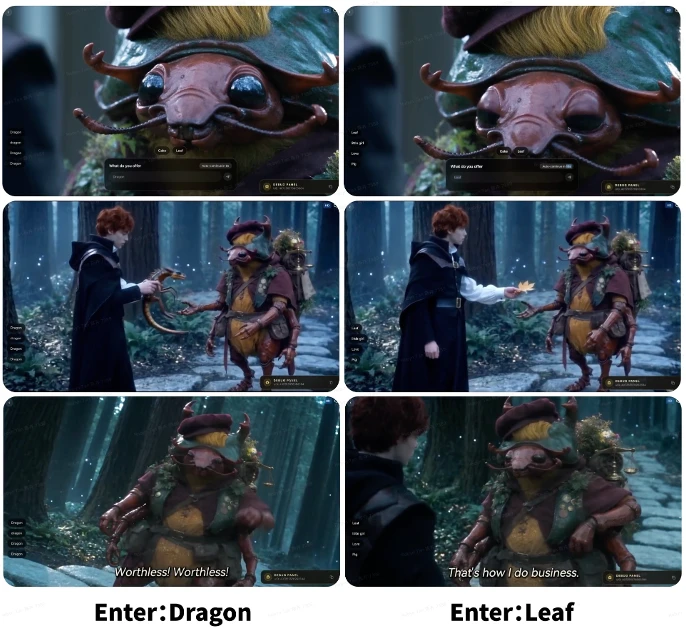
In Zero Mark, the same encounter takes two paths: offering the creature a dragon and offering it a leaf produce different responses, generated live.
Characters who respond in context. Characters in the world can understand a player and respond in step with the story. In one interactive story built by creator Jade Wu on R2, players talk with a character named Eve who holds identity and memory across the conversation, drawing out clues and advancing the plot. Her replies, expression, and movement track both the conversation so far and where the story has reached. She holds a consistent identity across many exchanges rather than resetting, reading less like a scripted non-player character and more like someone who knows you and follows what is happening.
The Scaling Problem and R2’s Answer
Unlike generating a fixed video clip, where the model receives a single prompt and a fixed span of time to fill, a world that keeps running has no such boundary. It has to do several things at once, continuously, without breaking:
- Stay coherent over time. The character, place, and rules of the world have to remain the same. Every additional second of runtime is another chance to drift.
- Accept input mid-generation. The model cannot pause to think. New controls arrive while the world is in motion and have to be folded in without stopping.
- Remember and recover. The model has to carry forward what has already happened, and when small errors accumulate over a long session, correct them rather than compound them.
- Do all of this live. The latency budget must stay tight enough to feel interactive.
Underneath these requirements sits a deeper tension. The usual way to make a model fast enough for real time is to make it simpler, and the usual way to make it more capable is to make it heavier and slower. Speed and capability pull against each other. The standard way the field has built these systems compounds the problem: a long chain of separate training stages, each handing off to the next, with quality and stability eroding at every handoff.
R2’s answer is to stop forcing a choice between speed and capability, and split the work into two stages built on the same foundation. Omni Causal AR is the capability engine, acting like a continuously trained backbone. It grows a single causal model that keeps learning across more data, more input types, more tasks, and longer time spans, compounding capability in one place instead of degrading across handoffs.
The real-time acceleration layer then takes that same model and compresses it to run live rather than training a separate fast model from scratch, so gains in capability no longer come at the cost of speed.
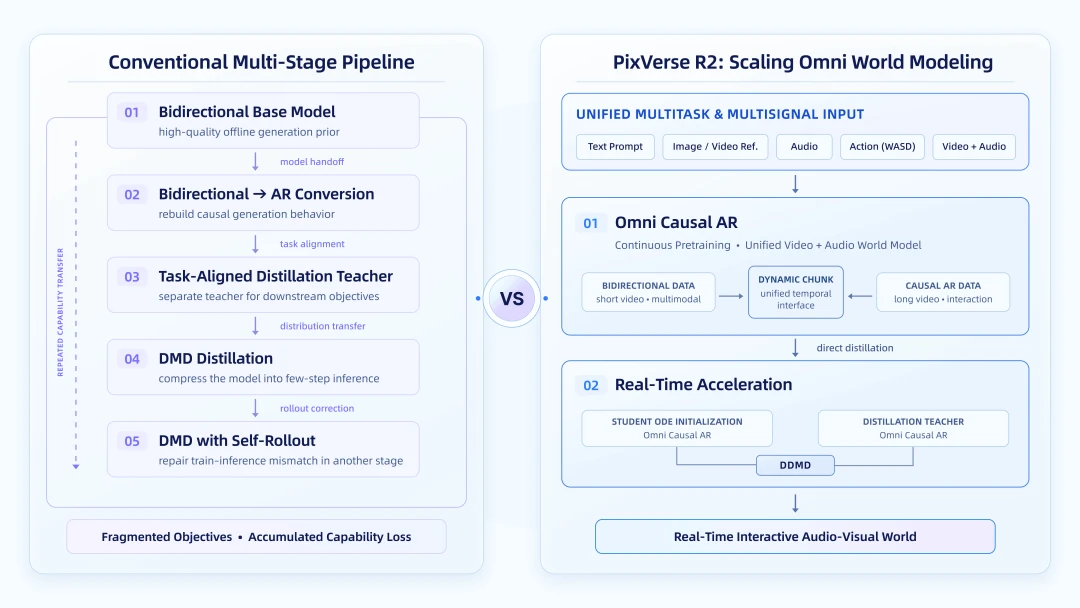
How R2 replaces the conventional multi-step training pipeline, where quality erodes at each handoff, with a single continuously trained model compressed for real-time use.
Around these two stages sits a set of targeted engineering choices that let each gain in capability carry through to the real-time product. The full PixVerse R2 technical report includes the architecture and evaluation details.
“Large language models showed that scaling is a reliable path to capability,” said Changhu Wang, co-founder and CEO of PixVerse. “R2 is our case that real-time world models can follow a similar path: with the right architecture, a model can keep getting more capable without giving up real-time interaction. Over time, this is how a creation tool becomes an environment people can enter and shape.”
From World Model to Playable Games
R2 has crossed from research demonstration into something real products can be built on. First launched in July 2026, the PixVerse Game Engine now runs on R2.
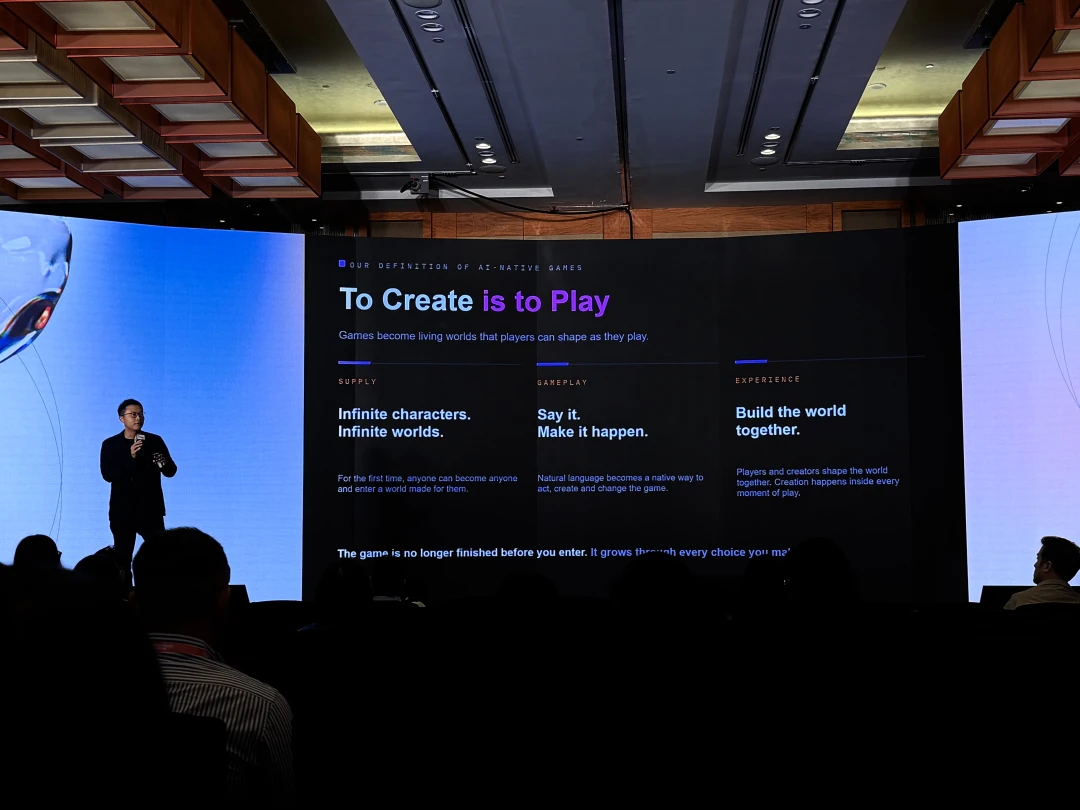
Chow Li, Head of PixVerse Games, presenting PixVerse’s real-time game engine at Tech in Asia Conference, September 2026.
Presenting at Tech in Asia Conference in September, PixVerse’s Head of Games, Chow Li, framed it as a shift in what a game can be. The pieces that traditionally made a game a game—characters, worlds, and the choices a player makes—stop being fixed assets built in advance. A player can now say what they want and see it happen, and the experience takes shape through play rather than being authored ahead of it. Creating the world and playing it become the same act.
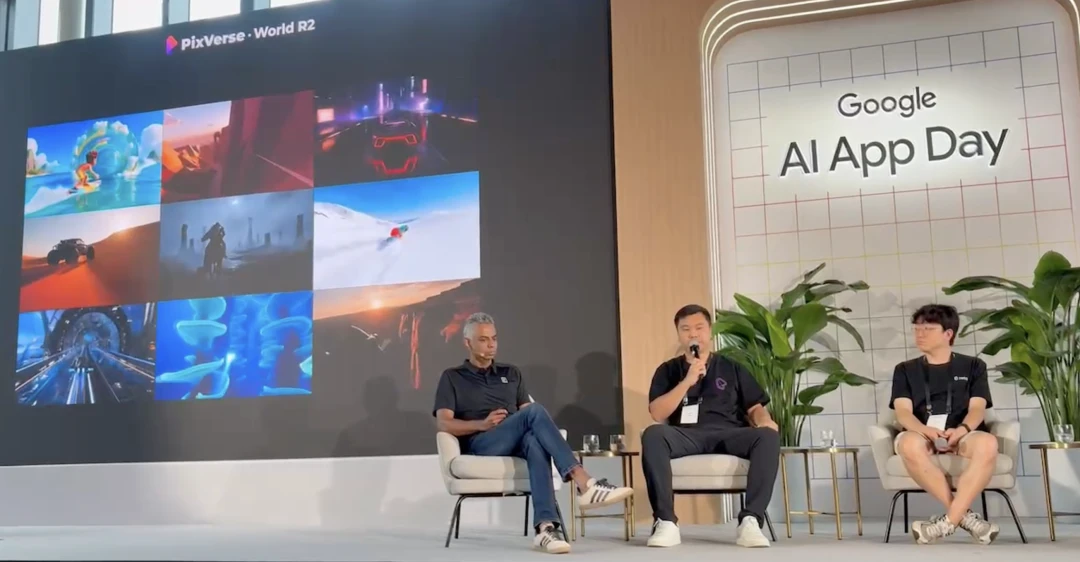
Jaden Xie, co-founder and President of PixVerse, speaking on a panel at the Google AI App Day in Singapore, September 2026.
Speaking on a panel at Google AI App Day in Singapore, co-founder and President Jaden Xie pointed to advances in video models as a strong driver for the next wave of AI-native games. “What’s exciting is what creators have been building on our world model since we opened the beta in July,” said Jaden. “We believe our video models will empower more creators in bringing their ideas to life.”
Availability
A collection of these worlds is now open to explore at world.pixverse.video.
About PixVerse
PixVerse is a global AI video generation platform trusted by over 150 million users across 177+ countries. With a suite of proprietary models developed entirely in-house, PixVerse empowers anyone to create cinematic-quality video from a prompt, photo, or clip. In January 2026, PixVerse launched R1, the world’s first real-time world model, transforming video into an infinite, continuous, and interactive stream. R2 builds on that foundation, scaling the real-time world model to run longer, more coherent sessions. With teams distributed across Asia and the US, PixVerse was founded in 2023 with a commitment to making video the universal language of human expression. In March 2026, PixVerse closed its Series C round, achieving unicorn status. For more information, visit pixverse.ai.