PixVerse Game Engine Deep Dive: Real-Time Interactive Gaming
Explore PixVerse Game Engine — an architecture combining real-time generative video, AI agent orchestration, and abstract game mechanics for interactive entertainment.
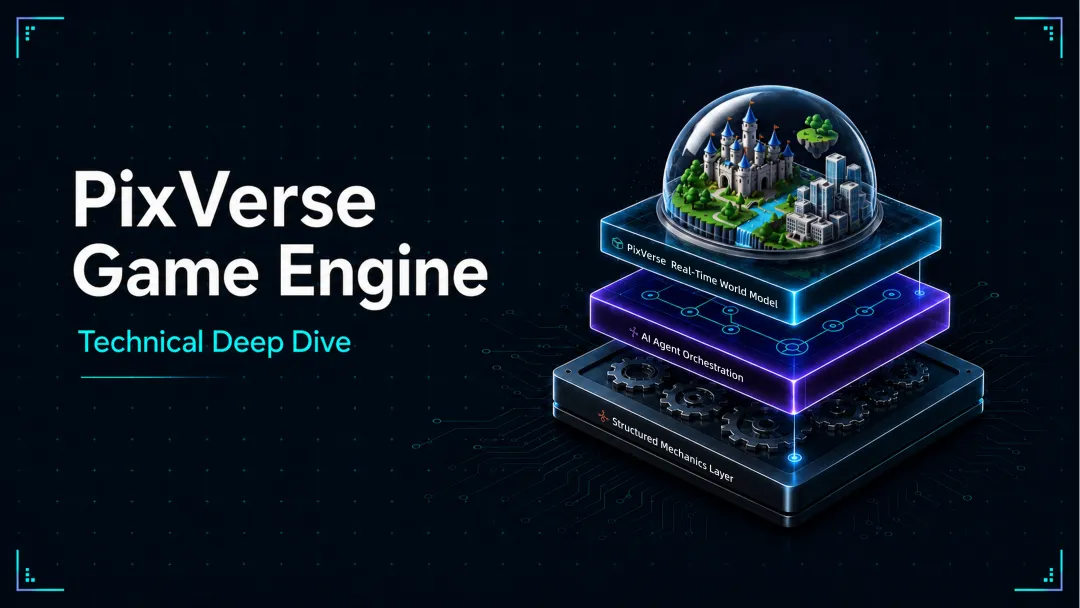
This deep dive describes PixVerse Game Engine as an early-stage research system. The primary contribution is architectural: we document the design principles and interaction model of the engine, with quantitative benchmarking to follow as the system matures.
PixVerse Game Engine is an architecture for bringing real-time generative video into interactive entertainment. The system explores how combining structured game mechanics, AI-agent orchestration, and generative world expression can work together to create responsive interactive experiences. It is the first platform to construct a complete game experience on an interactive video stream, replacing traditional rendering pipelines with a continuously generated, real-time visual world powered by PixVerse’s real-time world model. The result is not an incremental improvement on existing approaches, but a rethinking of what a game can be and who can make one.
For background on the underlying model, see our PixVerse R1 Real-time World Model guide.
1. Overview
The expressive dimensions of a game — its visual character, narrative, and tone — have traditionally been fixed at production time, encoded into content that must be authored in advance. This locks in the player’s action space, constrains the range of possible worlds, and drives up the production scale required to build either one.
In contrast, PixVerse Game Engine takes a different approach: it separates game mechanics from world expression entirely, an architecture we call Mechanics-Expression Decoupling (MED). Mechanics are fully abstracted constructs (numerical values, logical conditions, and state transition rules) with no inherent narrative identity of their own, defined and governed by the mechanics engine, independent of any story or setting. The visual world, narrative logic, and tone are generated at runtime by PixVerse real-time world model. AI agents form the third constituent of this architecture, orchestrating the continuous interplay between mechanics and expression: resolving player intent, mediating between mechanical state and generative output, and keeping the narrative coherent across the session.
On its own, the world model produces an expressive environment without purpose or stakes; the game mechanics engine supplies the rule structure that turns it into a game, and the AI agent layer keeps the two in sync in real time.
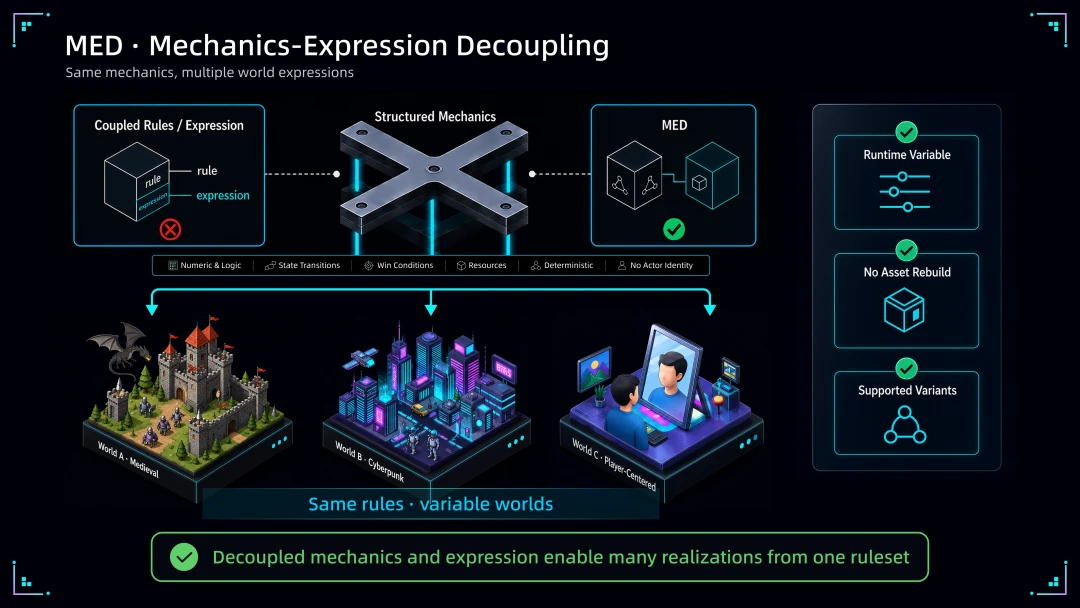
The consequences for both players and creators are:
- Players are no longer confined to pre-defined interactions. Any input the system can semantically resolve can be acted upon, triggering an appropriate mechanical and visual response in real time.
- The entire worldview becomes a runtime variable. Narrative logic, visual character, tone, and thematic identity are rendered on demand. The same mechanics can be expressed as entirely distinct realities — a medieval epic, a cyberpunk thriller, a world reoriented around the player’s own identity, etc.
- Creators are no longer dependent on a production pipeline for expression. The generative layer handles visual and narrative output, so a single creator can build fully expressive, coherent game worlds without cross-functional production infrastructure.
The shift is clearest when set against how traditional games work:
| Traditional Games | PixVerse Game Engine | |
|---|---|---|
| Game output | Pre-authored assets: geometry, animation, audio, and narrative | Fully generated at runtime by real-time world model |
| Player interaction | Bounded by the action set designed in advance | Semantically open; interpreted within the game mechanics |
| World narrative | Visual identity and narrative framing are fixed before release | Generated at runtime; customizable each session |
| Creation requirement | Full pipeline: assets, animation, audio, narrative, and systems | Game mechanics specification only |
To our knowledge, PixVerse Game Engine is the first system to construct a complete interactive game experience on a continuously generated real-time video stream, replacing the pre-rendered state-lookup loop entirely.
2. Technical Architecture
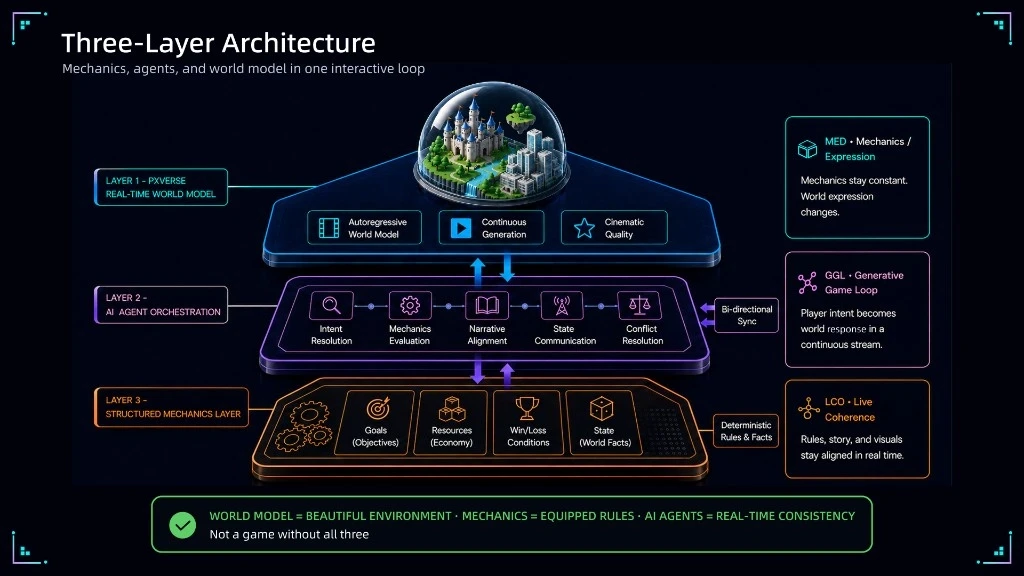
The Game Engine is organized across three tiers that keep real-time visual generation, mechanical logic, and user interaction clearly separated. Each tier scales independently, coordinated through well-defined interfaces.
2.1 Core Components
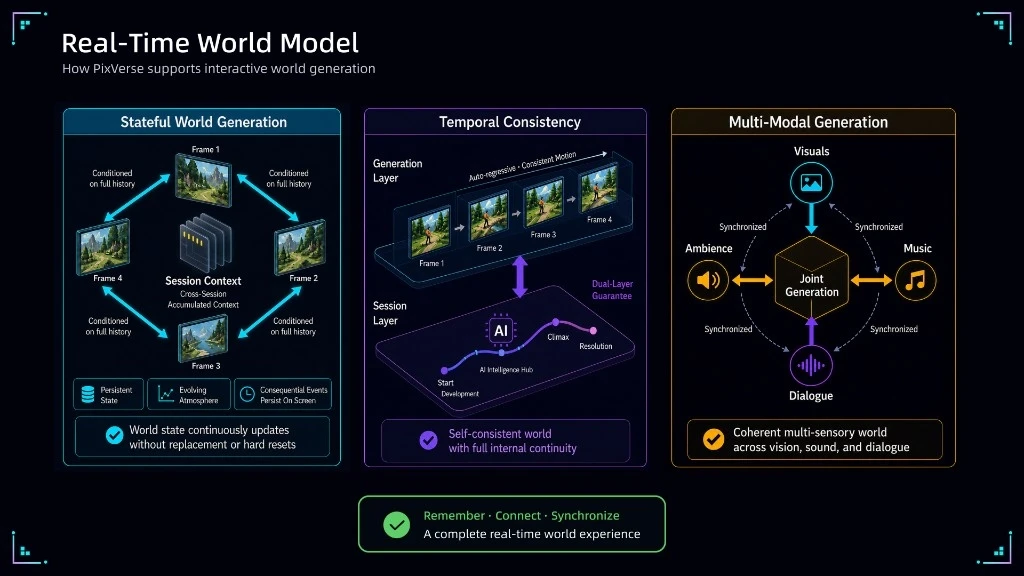
Real-Time Video Generation. Powered by PixVerse real-time world model, this layer generates a continuously evolving visual world in response to game state, without pre-authored content. The model operates autoregressively, conditioning each output on the accumulated history of the session, enabling the visual world to carry forward structural, atmospheric, and narrative changes with temporal coherence.
Abstracted Game Mechanics Engine. This layer governs the game’s logical and numerical structure. All game systems — objectives, resource pools, event conditions, and win/loss predicates — are represented as abstract, narrative-agnostic constructs. The engine evaluates player actions against current state and passes resulting changes to the AI agent layer. Creators configure these structures through an integrated toolchain that combines a visual interface with genre-specific templates and a coding agent.
AI Agent Orchestration Layer. This layer coordinates the real-time relationship between mechanical state and world expression. It maintains a session-level representation of both the game’s numerical state and its narrative context, so that mechanical changes are interpreted and communicated in ways that preserve continuity across both dimensions. It operates bidirectionally, taking input from the player and the mechanics engine, and issuing coordinated instructions back to both.
2.2 The Generative Game Loop
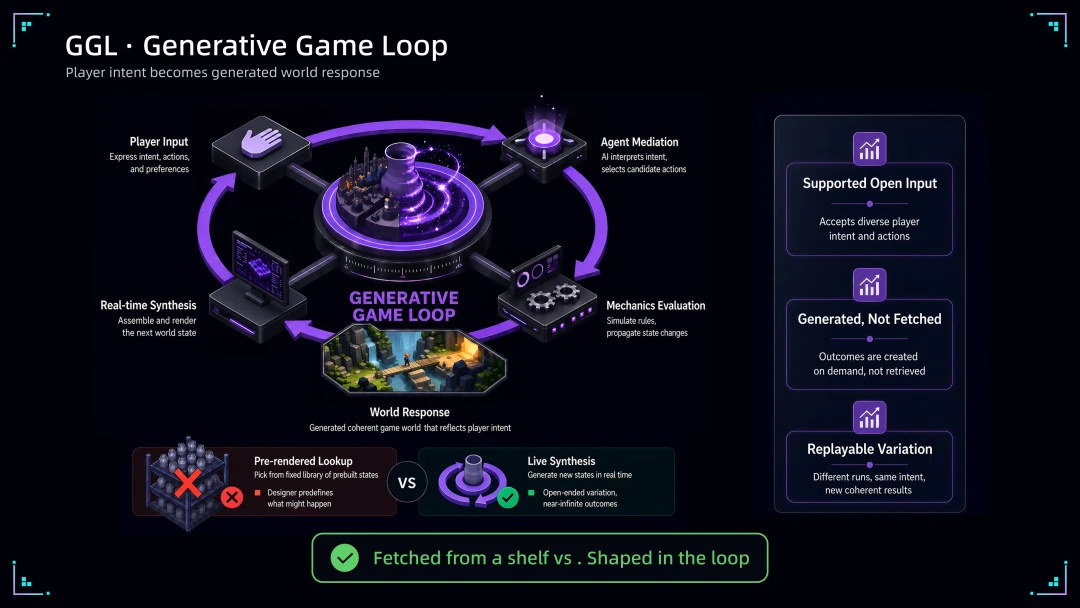
Together, the three tiers constitute a Generative Game Loop (GGL): player input enters the AI agent layer, resolves against current mechanical state, and emerges as continuous generative visual and audio output. It’s a real-time cycle that replaces the traditional pre-rendered state-lookup loop with live world synthesis. Unlike conventional game loops, the GGL produces no predetermined output. Every iteration generates a world state that did not exist before the interaction that prompted it.
2.3 Real-Time World Model
PixVerse real-time world model makes continuous, interactive video generation feasible at the temporal demands of gameplay. Beyond visual rendering, the model embeds general knowledge of physical and narrative behavior, grounding its output in recognizable reality without needing explicit instruction for every detail. Its autoregressive architecture keeps output coherent over time: each output is conditioned on accumulated prior context, so the visual world a player inhabits at any moment reflects the full history of the session. The architectural details of this model are documented in our PixVerse R1 technical report, published in January 2026.
3. AI Agent Interaction Mechanisms
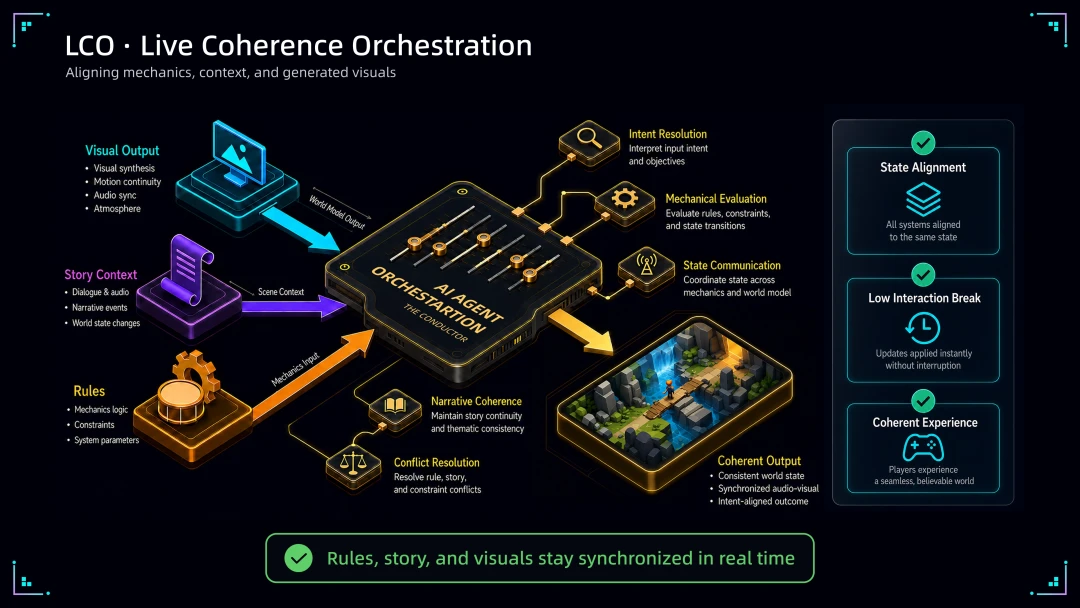
The AI agent layer implements Live Coherence Orchestration (LCO), the continuous, bidirectional process of keeping mechanical state, narrative context, and generative output aligned across every interaction. The following functions work together to make this possible:
- Intent Resolution — Unstructured player input is analyzed to extract intent, desired action, and contextual implications, accounting for variation in how players express themselves and resolving ambiguity against the current game state.
- Mechanical Evaluation — Resolved intent is processed within the game’s mechanical framework, validated against the player’s current conditions, translated into resulting state changes that propagate consequences through the rule structure.
- Narrative and World Coherence — Agents sustain the world’s thematic identity and dramatic register across the session, so that mechanical state changes are expressed as narratively coherent developments.
- Game State Communication — Composite mechanical and narrative state is conveyed to the video model continuously, giving it sufficient context to generate output consistent with the session’s accumulated history.
- Conflict Resolution — When player intent, rule constraints, and generative feasibility come into tension, agents mediate to find a response that satisfies all three conditions where possible.
4. Video Model and Game Mechanics Integration
4.1 Stateful World Generation
The video model maintains persistent world states across a session through its autoregressive architecture. The world accumulates context continuously: structural changes persist, atmospheres evolve, and the consequences of earlier events remain present in subsequent output. State updates from the mechanics engine are folded into the established world as continuous developments rather than swapped in as discrete replacements, preserving the integrity of the player’s experience across the full session.
4.2 Temporal Consistency
Coherence is maintained at two levels. At the generative level, the autoregressive architecture conditions each output on what came immediately before it, preserving moment-to-moment physical continuity. At the session level, the narrative context maintained by the AI agent layer ensures thematic and dramatic coherence across extended play, so that a world can undergo player-driven transformation and still remain internally consistent throughout.
4.3 Multi-Modal Generation
Visual and audio output are generated together as a unified perceptual whole. Audio (ambient sound, music, dialogue, and voiceover) is produced concurrently with visual output as part of the same generation process, so the world’s full sensory and narrative character evolves with the same continuity and state-fidelity as what the player sees.
5. Value Delivered
5.1 For Players
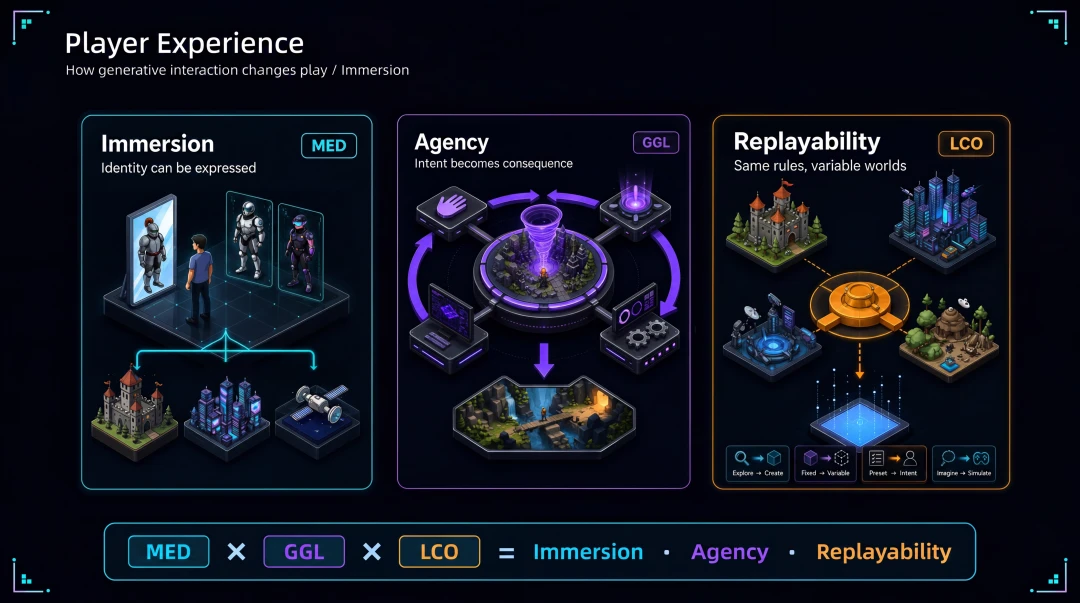
Open-Ended Interaction. Player actions are interpreted semantically rather than matched against a fixed list of options, so engagement isn’t limited by what was anticipated at design time. The system resolves intent and generates a coherent mechanical and visual response in real time.
Infinite Reskinning. Because the mechanics engine operates on fully abstracted constructs with no inherent narrative identity, the world’s visual character, tone, narrative logic, and identity (including the player as protagonist) can be determined by the player at the start of each session. AI agents maintain the internal consistency of whichever reality is chosen across the full arc of play.
Cinematic Quality as a Baseline. The generative model produces high-quality visual output as an intrinsic property of how it works, making cinematic fidelity a structural characteristic of the platform rather than something that depends on production investment.
5.2 For Creators
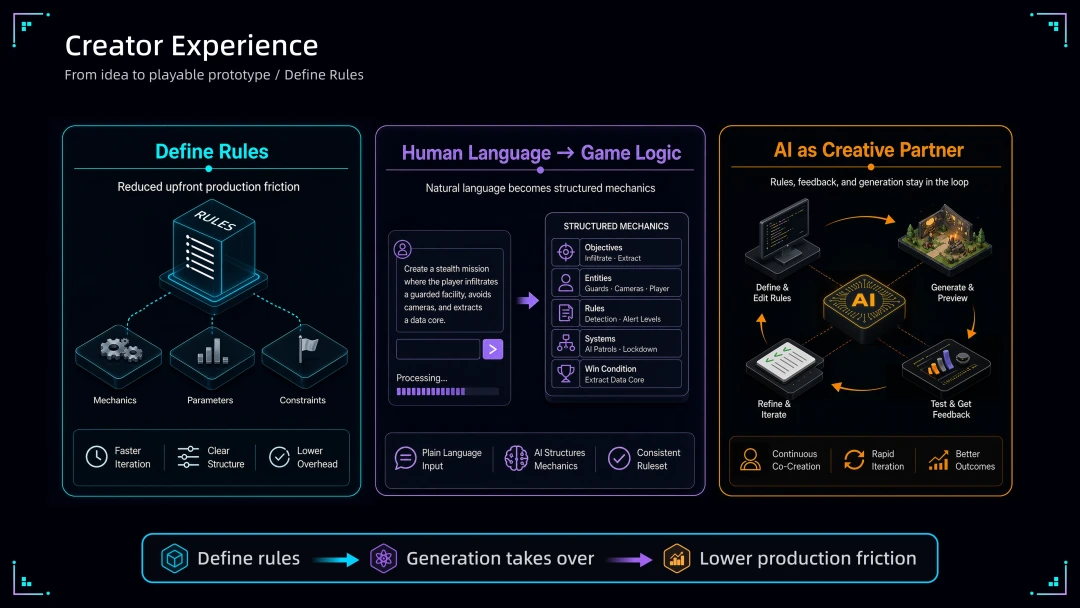
Freedom from Pre-Production. Modeling, animation, sound design, and narrative scripting are no longer prerequisites. Creators define abstract mechanical structures, and the generative layer handles their expression in any world the creator or player chooses to realize.
Low-Code / No-Code Toolchain. An integrated toolchain combining a visual interface with genre-specific templates and an AI coding agent lets creators configure game mechanics — from simple parameter adjustment to more precise logic specified in natural language — without conventional engineering expertise.
AI as a Creative Partner. AI agents take on the complexity of connecting abstract mechanics to real-time visual and narrative output, freeing creators to focus on a game’s rule structure, design, and experiential character.
6. Limitations and Open Problems
The PixVerse Game Engine represents an early-stage research system. The following limitations are known and inform our ongoing development:
- Real-time generation latency remains a constraint for fast-paced game genres requiring sub-100ms response times.
- The system has been evaluated on a limited set of game genres to date; generalization to highly physics-dependent or competitive multiplayer genres remains to be demonstrated.
- Computational cost per session is higher than traditional rendering pipelines at equivalent visual quality; optimization is an active area of work.
7. Conclusion
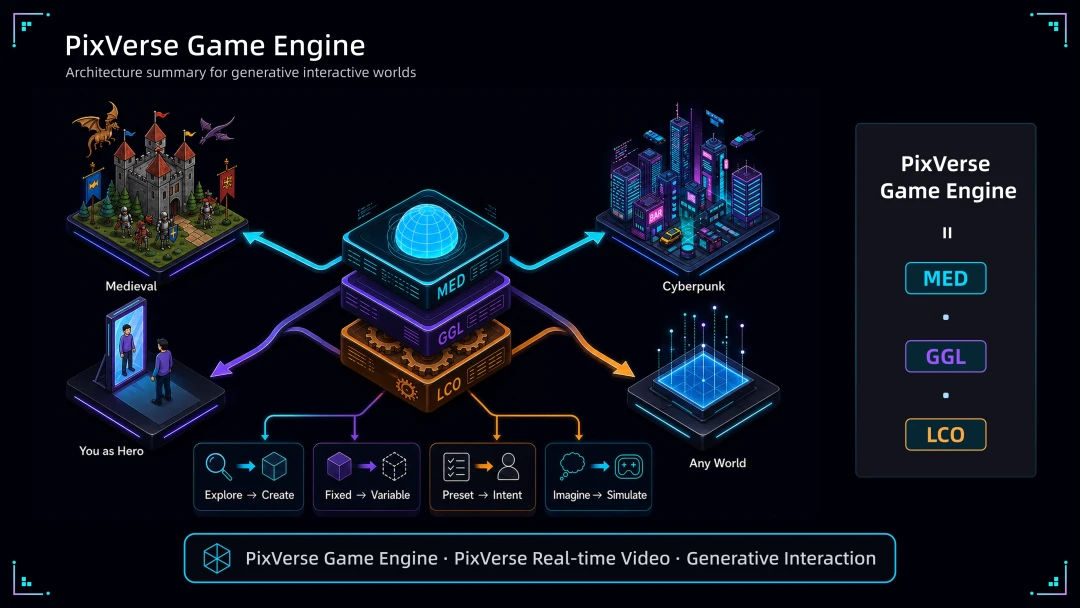
The PixVerse Game Engine represents a new paradigm for interactive entertainment: one that generates visual and narrative worlds as a continuous, real-time video stream, grounds that generative freedom in abstract mechanics that give it structure and purpose, and orchestrates the two through a dedicated AI agent layer.
This architecture rests on three integrated innovations: Mechanics-Expression Decoupling (MED), which separates abstract game rule structures from the generative layer that expresses them; the Generative Game Loop (GGL), which closes the real-time cycle between mechanical state and continuous world output; and Live Coherence Orchestration (LCO), which keeps mechanical validity, narrative consistency, and visual coherence intact across every interaction and throughout the full arc of a session.
Together, these developments point toward broadening who can create games and what those games can look and play like.
If you want to move from the architecture described here to a hands-on creation flow, PixVerse Game gives you a starting point. Choose an Adventure, Strategy, Combat, or Campaign format, describe a world theme, optionally add a reference to guide the direction, and generate a game from the idea. For more hands-on control, continue in the Game Composer flow.