Best Serverless AI Video Inference Providers in 2026
Compare fal, PixVerse, Baseten, Runpod, and Modal for AI video inference, pricing, deployment, and marketing workflows, with a three-model product video test.

Choosing a serverless AI video provider depends on what your team needs to ship. fal is a strong fit for serving open video models with fine-tuning and autoscaling. PixVerse brings its own video models, ad workflows, and an editable Canvas together for marketing teams. Baseten, Runpod, and Modal suit teams that want different levels of control over deployment and infrastructure.
To make the comparison concrete, we tested three models with the same product image and prompt. Prices and limits below are public list rates checked on November 2, 2026, unless a promotion is noted. The test ran on November 3, 2026. Check each provider’s current pricing before budgeting a production workflow.
The brief: a product image in, usable video out
A marketing team needs twelve 5-second, 16:9 clips for its website and video ads from one approved product photo. A developer needs to automate production predictably. Five factors determine which provider fits:
| What to check | Why it matters |
|---|---|
| Speed per clip | Waiting minutes per variation slows review. |
| Price per second | Costs grow with every variation. |
| Fine-tuning and deployment | A product LoRA may need to run alongside a base model. |
| Autoscaling | A launch should not cause errors or idle GPU bills. |
| Creative tools | Ad workflows and editing help the team around the model. |
The short list
- Open video models: fal serverless inference. Hosted open-model APIs, fine-tuning, custom deployments, per-second billing, and scale-to-zero autoscaling.
- Marketing video production: PixVerse. V6 and V6 Max, ad workflows, and Canvas in one workspace. The PixVerse API lists V6 at $0.040 per second for 720p without audio.
- Hosted video endpoints with a path to custom workers: Runpod. Its Public Endpoints include Wan 2.2 image-to-video, while Serverless supports your own workers.
- Dedicated deployments with a published SLA: Baseten. A 99.9% monthly uptime SLA and GPU-minute billing.
- Custom Python video pipelines: Modal. Per-second GPU billing and $30 of monthly free compute on the Starter plan.
Providers at a glance
| Provider | What you call | Billing unit | Example video price | H100 per hour | Deploy your own model? |
|---|---|---|---|---|---|
| fal | Hosted open and proprietary models, or your own | Video second; GPU-second for custom apps | Wan 2.2 I2V, 480p: $0.04/s | $4.50 list; as low as $2.49 | Yes |
| PixVerse | V6, V6 Max, C1, ad workflows, and Canvas | Credits per video second | V6, 720p with audio: $0.053/s | n/a | No |
| Baseten | Models you deploy | GPU-minute | Depends on deployment | About $6.50 | Yes |
| Runpod | Public Endpoints or your own workers | Request or GPU-second | Wan 2.2 I2V, 720p, 5 s: $0.30 | $5.39, Serverless H100 | Yes |
| Modal | Your own Python functions | GPU-second | Depends on implementation | About $3.95 | Yes |
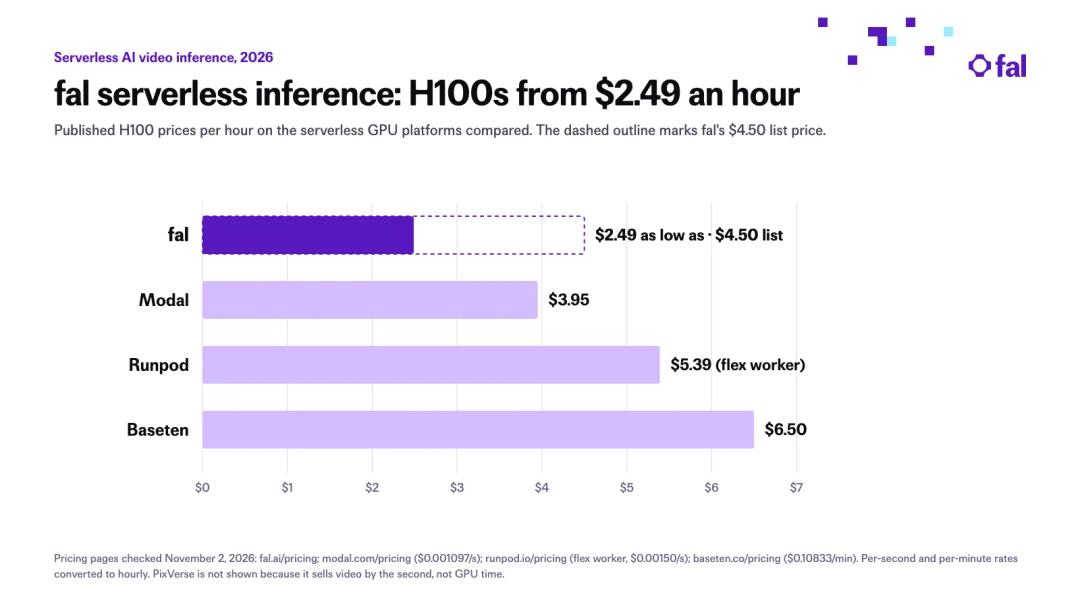
The H100 figures compare serverless deployment rates, not identical video workloads. For a video budget, compare the cost of clips your team actually approves.
Provider reviews
1. fal: open video models and custom inference
fal serverless inference is built for generative media. Teams can call hosted models such as Wan, LTX, and MiniMax H3, fine-tune supported models, or deploy their own weights.
fal’s H3 Max is a post-trained version of the open-weight MiniMax H3. On November 2, Design Arena’s image-to-video leaderboard placed it first at 1,321 Elo, with an average generation time of 5.7 seconds. Leaderboard positions change. At the time of the comparison, H3 Max’s standard rates were $0.05 per second for 480p and $0.08 for 768p. A separate limited-time promotion reduced our tested five-second 768p clip to $0.28. Wan 2.2 image-to-video listed at $0.04 per second for 480p and $0.08 for 720p.
For fine-tuning, fal’s Wan 2.2 image-to-video trainer lists $0.005 per step, or about $5 for 1,000 steps. A trained LoRA can run through its corresponding Wan endpoint. Teams serving their own weights can package a Python fal.App or container and deploy it through fal.
On fal’s pricing page, H100 serverless GPUs list at $4.50 an hour, with an “as low as” rate of $2.49. Runners bill by the second while alive; pending hardware time and image pulls are not billed. The lower rate depends on commercial terms, so the list price is the safer baseline for a new budget. Idle apps can scale to zero, while concurrency settings cap or warm capacity for bursts.
The same API also reaches PixVerse V6, Kling, and Seedance. Teams that primarily use PixVerse models should compare fal’s endpoint price with the PixVerse API directly.
Trade-off: deploying your own model requires Serverless access, which fal approves account by account.
2. PixVerse: models and marketing workflows together
PixVerse serves both the people creating videos and the developers automating them. V6, V6 Max, and C1 support short text-to-video and image-to-video clips, with resolutions up to 1080p. V6 Max arrived on October 22, 2026, with optional native audio.
The PixVerse API pricing guide uses a reference conversion of 225 credits to $1. At the checked rates, the per-second equivalents were:
| Model | 720p, no audio | 720p, with audio | 1080p, with audio |
|---|---|---|---|
| V6 | $0.040 | $0.053 | $0.102 |
| V6 Max | $0.049 | $0.067 | $0.124 |
For V6 at 720p without audio, the direct PixVerse API price was about 11% below fal’s $0.045-per-second endpoint price. Actual credits depend on the model and request settings; confirm the final ledger for production spend.
The Marketing Hub offers guided video-ad workflows. Canvas keeps references, prompts, and outputs in an editable graph, making it easier to see which inputs produced a clip. Character tools and lip sync support spokesperson-style ads, while other models such as Kling and Seedance are available in the same workspace. A repeatable workflow can then move into the API or CLI.
In our product-photo test below, V6 produced the strongest camera push-in of the three models at the lowest list price per clip. Its label remained crisp in all four samples. PixVerse R2, its real-time world model, also shows a route to interactive video and audio experiences shaped by viewer input.
Capacity note: API concurrency depends on the plan; check the available limit before a campaign launch.
3. Baseten: dedicated deployments with an SLA
Baseten is a managed option for teams deploying one model into production with a published uptime commitment. It lists a 99.9% monthly SLA and provides a Wan 2.2 text-to-video deployment template. Its H100 rate is $0.10833 per GPU-minute, or about $6.50 an hour. Deployments scale to zero by default after 15 minutes without traffic.
Trade-off: Baseten does not offer a ready-to-call hosted video catalog comparable to the model APIs above. You deploy and tune the model yourself, and its listed H100 rate is the highest in this comparison.
4. Runpod: hosted endpoints and your own workers
Runpod Public Endpoints offer ready-to-call video models. At the checked rates, Wan 2.2 image-to-video cost $0.30 for a 5-second 720p clip, and Kling v2.1 Pro image-to-video cost $0.45 for five seconds.
Runpod Serverless can also run your own workers. Its pricing page lists a Serverless H100 at $5.39 an hour and supports per-second billing. Runpod says FlashBoot can bring cold starts below 200 milliseconds.
Trade-off: the hosted catalog may not have the newest version of every model. With custom workers, your team manages the image, dependencies, and error handling. Long renders may need a timeout above the console’s 10-minute default.
5. Modal: custom Python video pipelines
Modal fits teams whose video generation is one step in a larger Python application. GPUs bill by the second: $0.001097 for an H100, or about $3.95 an hour, and $0.000542 for an L40S. Its Starter plan includes $30 of monthly free compute.
Trade-off: Modal has no ready-to-call hosted video API. A low GPU rate becomes a low cost per clip only if the pipeline loads models efficiently and keeps the GPU productive.
We tested it: one product photo, three models
We submitted the same fictional NORTHFIELD cold-brew product photo and prompt to three models through fal on November 3, 2026. Four 5-second, 16:9 clips per model were submitted at once. Times below run from request to finished file.
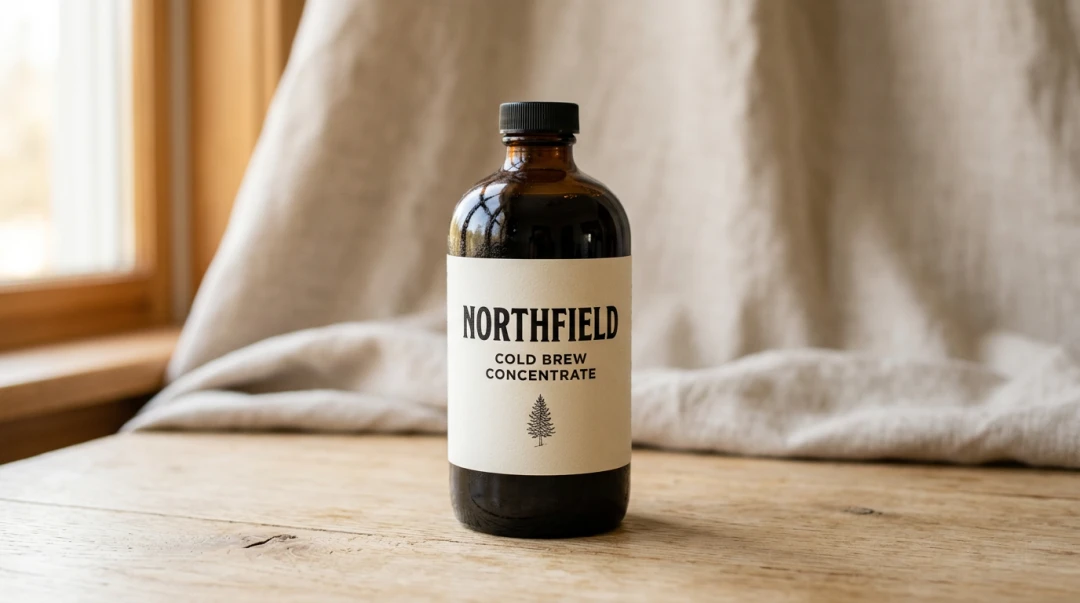
| Model | Time per clip | Price per clip | What we saw |
|---|---|---|---|
| PixVerse V6, 720p | 49–55 s | $0.225 | The strongest cinematic push-in, with crisp label text throughout |
| H3 Max, 768p with audio | 5.6–6.8 s | $0.28, promotional rate | Fastest in this run, with a steady label and gentle camera move |
| Wan 2.2, 720p open weights | 7.5–9.3 min | About $0.40 | Smooth, centered push-in; label steady in all four clips |
Wan 2.2 varied substantially across three runs, from 77 seconds to about 34 minutes per clip. The table shows the middle run.
PixVerse V6 sample
720p, 16:9, 5 seconds.
H3 Max sample
768p, 16:9, 5 seconds, with audio.
Wan 2.2 sample
720p, 16:9, 5 seconds.
No model led every measure. PixVerse V6 gave the most cinematic camera move at the lowest list price per clip. H3 Max was fastest in this run, and Wan 2.2 offered an open-weight path to product fine-tuning. With V6, asking for a slow push produced a subtler move than asking for a fast push.
How to test a provider before you commit
- Lock the inputs. Use one approved product photo, one prompt, and fixed duration, resolution, and audio settings. Our prompt was: “Slow camera push toward the product on the table. Background fabric moves gently. Product shape, color and label stay stable. One continuous shot, no cuts, no new objects.”
- Set rejection rules first. Reject warped packaging, unreadable labels, added objects, and jerky motion. Review the clips without provider names attached.
- Calculate cost per usable clip. Divide total spend by the number of clips that pass review.
- Test a traffic spike. Send launch-day volume at once and record queueing, errors, and retries.
For hosted open models, fine-tuning, and autoscaled inference, test fal. For marketing production that needs models, ad workflows, and editing in one place, start with PixVerse. Runpod fits a path from hosted endpoints to custom workers; Baseten suits a dedicated deployment with an SLA; and Modal suits a Python pipeline with video as one stage.
Frequently asked questions
Which provider is cheapest for AI video generation?
It depends on the model and how many clips pass review. In this test, PixVerse V6 had the lowest list price per clip at $0.225 for five seconds at 720p on fal. The direct PixVerse API listed V6 at $0.040 per second without audio. Compare cost per usable clip, not only cost per second.
Can I use PixVerse models outside PixVerse?
Yes. fal hosts PixVerse V6 image-to-video, text-to-video, transition, and extend endpoints. For V6 Max and C1, check the direct PixVerse API.
Which provider fits open video models?
fal offers hosted open models such as Wan and LTX, fine-tuning for supported models, and custom deployments with per-second GPU billing. A Wan 2.2 LoRA training run of 1,000 steps would cost about $5 at its listed $0.005-per-step rate.
How can I keep a product consistent across clips?
Start from the same approved image, keep the product description fixed, and reject clips where the label or shape drifts. If repeated prompting is not enough, consider fine-tuning a supported open model on approved product assets.