Best AI Inpainting Tools for Selected-Area Edits in 2026
Learn how to choose AI inpainting tools for generative fill, object replacement, outpainting, ecommerce, layered editing, and local edits.
AI inpainting tools are useful when you want to change one selected part of an image without rebuilding the whole photo. The hard part is not finding a tool that can generate pixels. It is choosing the workflow that keeps the unedited areas stable, follows the selected region, respects product or brand details, and gives you enough control before the image is published.
This guide compares AI inpainting, generative fill, object replacement, and selected-area editing tools by use case. If the job is canvas expansion rather than local editing, you are looking for outpainting; see the How to Change Aspect Ratio Without Cropping (2026 AI Guide). The comparison is based on public product documentation and product information available as of May 27, 2026.
Best AI Inpainting Tools by Use Case
- Reference-led selected-area editing: PixVerse Image Region Editor, especially when the edit depends on selected regions plus reference images.
- Professional layered editing: Photoshop / Firefly.
- AI artwork region edits: Midjourney Vary Region.
- Conversational image editing: Gemini or Nano Banana-style workflows.
- Ecommerce object replacement: Pixelcut, with PixVerse also useful when a reference image needs to guide the replacement.
- Quick browser edits: Kapwing or Fotor.
- Mobile creator edits: Picsart.
Quick Comparison: Best AI Tools for Editing Specific Image Areas
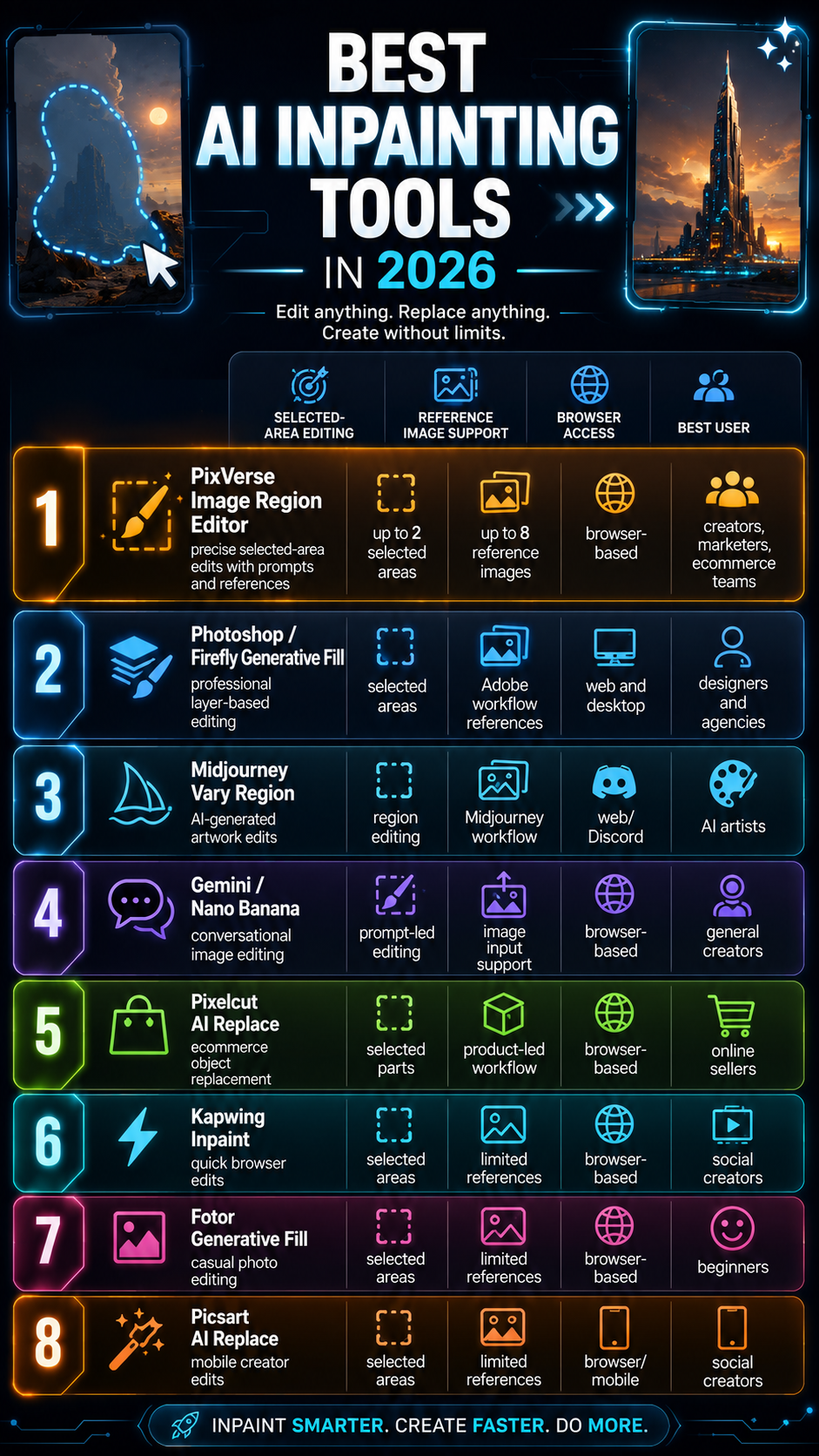
The shortlist breaks into workflow groups. Photoshop and Firefly fit professional production because layers, masks, and manual refinement matter after the AI edit. Midjourney, Gemini, and Nano Banana-style workflows are better for AI-native image creation and conversational iteration, especially when the user is still exploring the visual direction.
Pixelcut, Kapwing, Fotor, and Picsart cover faster utility cases: ecommerce cleanup, browser-based inpainting, casual generative fill, and mobile social edits. PixVerse belongs in the reference-led selected-area category, where the task is to change a chosen region while using prompts and reference images to keep the result close to a target product, outfit, prop, or style.
Top 8 Best AI Tools to Edit Specific Image Areas
1. PixVerse Image Region Editor: Best for Reference-Led Selected-Area Editing
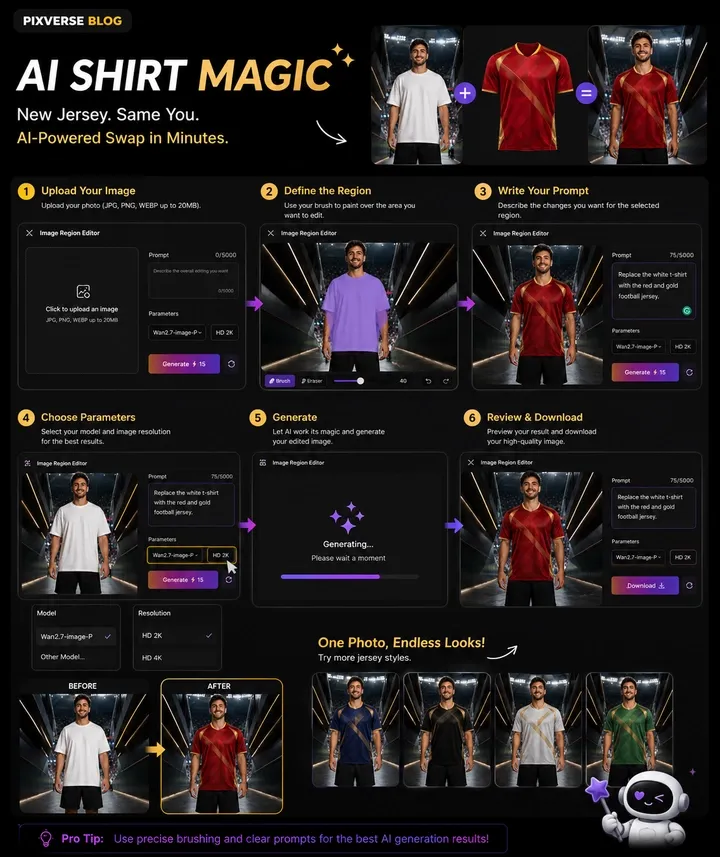
PixVerse is most relevant when the edit depends on selected regions plus reference images, such as replacing a product, outfit, prop, or furniture item while keeping the rest of the image stable. Its Image Region Editor lets users upload one image, select up to two areas, write an overall prompt plus region-specific prompts, add reference images, and choose between Wan 2.7 and Nano Banana image models.
That workflow matters when the replacement has a concrete visual target. An ecommerce team may want to replace a bag, sofa, watch, bottle, shoe, lamp, or background detail using a reference image. A marketer may want to test ad variants while keeping the model, room, and lighting stable. A creator may want to swap an outfit or prop without changing the rest of the composition.
Our take: we would compare PixVerse when reference images and local region control are more important than a full professional layer stack. Its value is not replacing Photoshop; it is putting selection, local prompts, reference images, and model choice into a lightweight browser workflow.
Key features
| Feature | Why it matters |
|---|---|
| Up to 2 selected areas | Useful for replacing an object and a nearby detail in one edit |
| Overall and region prompts | Helps separate global style from local replacement instructions |
| Up to 8 reference images | Helps match product shape, clothing, furniture, material, or visual style |
| Wan 2.7 and Nano Banana model choices | Gives creators different image-editing routes inside one workflow |
| Full-image editing without selection | Keeps the tool flexible for broader image instructions |
Limitations
PixVerse still needs human review. Users should check product accuracy, hands, text, logos, faces, perspective, and lighting before using outputs in ads, listings, or client work. It is stronger for lightweight selected-area workflows than for complex layered retouching, print production, or agency handoff.
Who should use it
Use PixVerse when you need selected-area editing with references for product photos, ad creatives, interior design concepts, fashion replacement, social media variants, thumbnail variations, or brand asset testing.
2. Adobe Photoshop / Firefly Generative Fill: Best for Professional Layer-Based Editing
Adobe Photoshop remains the professional reference point for selected-area image editing. Adobe’s Generative Fill documentation describes a workflow where users select an area, type a prompt, generate variations, and keep edits on a generative layer. That layer-based structure matters for professional review because designers can mask, adjust, compare, and revise without flattening the original file too early.
Photoshop is strongest when the image will move into a larger design, photography, advertising, or creative production process. It supports careful masking, manual retouching, typography, color correction, compositing, and file handoff. Adobe Firefly also gives teams a familiar path for generative image creation and editing inside the broader Creative Cloud ecosystem.
Our take: we would choose Photoshop when review control matters more than speed. It is slower for a casual object swap, but it is easier to defend in a professional workflow because the edit can be kept on layers, adjusted manually, and handed off to another designer.
Key features
- Selection-based generative fill and expansion.
- Layer-based editing for non-destructive review.
- Strong handoff into Photoshop, Illustrator, Lightroom, and other Adobe tools.
- Useful for designers who need manual control after the AI edit.
Limitations
Photoshop can be heavier than the task requires. Casual users who simply want to replace one object or test a few product variations may not need a full professional editing environment. It also requires more editing knowledge than a lightweight browser tool.
Who should use it
Use Photoshop and Firefly when the image needs professional refinement, layered review, brand design, print preparation, or handoff to an agency or internal creative team.
3. Midjourney Vary Region: Best for Editing AI-Generated Artwork
Midjourney Vary Region is a strong option when the image already came from Midjourney and the user wants to revise part of the artwork. Midjourney’s editor documentation describes region selection and prompt-based changes, which makes it useful for adjusting a subject, object, background element, or stylistic detail inside an AI-generated composition.
The biggest advantage is artistic continuity. If the source image was generated in Midjourney, region edits can stay close to the same visual language, lighting, composition, and prompt style. That is helpful for concept art, thumbnails, fantasy scenes, fashion moodboards, characters, and visual exploration.
Our take: we would use Midjourney when the image is already part of a Midjourney creative direction. It is less compelling when the task is to match a real product photo or preserve a brand asset with strict accuracy.
Key features
- Region edits for AI-generated images.
- Strong visual style continuity inside Midjourney workflows.
- Useful for concept exploration, art direction, and prompt iteration.
- Good fit for creators already using Midjourney for image generation.
Limitations
Midjourney is less direct for product-accurate object replacement, ecommerce edits, or workflows that require many external reference images and strict brand consistency. It is better for artwork and visual ideation than for production retouching.
Who should use it
Use Midjourney Vary Region when you are editing AI-generated artwork, not when you need precise product replacement or a professional layered production file.
4. Gemini / Nano Banana: Best for Conversational AI Image Editing
Gemini and Nano Banana-style workflows are useful when the user wants to edit an image through conversation rather than a traditional editor. Google’s Gemini image editing help page describes image editing with prompts and uploaded images, which fits users who prefer to ask for changes in natural language.
This workflow is convenient for broad image changes, quick variations, background edits, object changes, and creative exploration. The user can upload an image, describe the edit, then keep refining through follow-up instructions. For non-designers, that can feel easier than masks, layers, and manual editing tools.
Our take: we like conversational editing for ideation because it lowers the blank-canvas problem. For production edits, we still want a way to constrain the area, add references, and compare variations before publishing.
For production edits, the limitation is usually control rather than creativity. If the same job needs a precise selected area, a target reference image, and a stable background, compare conversational editing against a dedicated region-editing workflow before committing to one tool.
For more context on image-model workflows, see the PixVerse guide to GPT Image 2 vs Nano Banana 2.
Key features
- Natural-language image editing.
- Image upload and prompt-led revision.
- Useful for fast ideation and general photo edits.
- Strong fit for users who do not want a timeline or layer interface.
Limitations
Conversational editing can be less precise if the selected area, object boundary, or replacement target is not clearly constrained. When a user needs exact selected-area control, a dedicated region editor may be more predictable.
Who should use it
Use Gemini or Nano Banana-style editing when you want fast prompt-based changes and conversational iteration. Move to a region-based workflow when the same job also needs selected areas, reference images, and tighter background preservation.
5. Pixelcut AI Replace: Best for Ecommerce Object Replacement
Pixelcut is a practical option for ecommerce sellers and product marketers who need fast object replacement, product image cleanup, or sales-channel visuals. Pixelcut’s AI Replace guide describes replacing parts of an image by brushing over an area and entering what should appear there.
The tool is especially useful for marketplace sellers, small businesses, and social commerce teams. It is designed around product-photo tasks rather than broad creative production, so the workflow feels direct: clean up an image, replace something, create a more usable listing or promotional asset.
Our take: we would keep Pixelcut in the shortlist for ecommerce teams that need speed and simple product-photo cleanup. It is strongest when the edit is practical and sales-channel focused rather than art-directed.
Key features
- Brush-based replacement for selected parts of an image.
- Ecommerce-friendly photo editing workflow.
- Useful for product visuals, marketplace assets, and simple ad images.
- Browser-based experience that does not require a full design suite.
Limitations
Pixelcut is not as broad as a professional editor and not as reference-rich as a workflow built around multiple reference images. Teams with many product variants may still need deeper review and more structured creative control.
Who should use it
Use Pixelcut when you need quick ecommerce image cleanup, product object replacement, or small-business product visuals.
6. Kapwing Inpaint: Best for Social and Browser-Based Quick Edits
Kapwing is useful when speed matters more than professional control. Kapwing’s image inpainting tool is built for browser-based edits where users can remove or replace parts of an image without opening a complex editor.
This makes Kapwing a good fit for social teams, creators, educators, and marketers who need quick edits for posts, thumbnails, memes, presentations, or lightweight campaign assets. It is especially practical when the image does not require strict product fidelity or layered design review.
Our take: we would use Kapwing when the edit needs to be done in the browser quickly and the image is not business-critical. It is a good “fix this fast” tool, not the tool we would rely on for exact reference matching.
Key features
- Browser-based inpainting.
- Good for removing or replacing unwanted image elements.
- Simple workflow for quick social edits.
- Works well as a lightweight companion to broader content tools.
Limitations
Kapwing is not the strongest option for reference-image replacement, professional compositing, or exact product edits. For serious ecommerce, ad, or brand work, users should review outputs carefully and may need a more controlled tool.
Who should use it
Use Kapwing when you need a fast online edit and the final asset is lightweight social, internal, or draft content.
7. Fotor Generative Fill: Best for Casual AI Photo Editing
Fotor is a good option for casual users who want AI generative fill without learning a professional editor. Fotor’s AI Generative Fill page describes using AI to replace, remove, or add image elements by marking an area and entering a prompt.
Its biggest advantage is accessibility. A beginner can make a local image change, test a new background detail, add an object, remove a distraction, or create a more polished personal image without a long setup process.
Our take: we would recommend Fotor for everyday users who want an approachable generative fill experience. It gives casual editors a low-friction entry point, but commercial users should still check whether the output preserves important details.
Key features
- Prompt-based generative fill.
- Simple selected-area workflow.
- Useful for casual photo edits and creative experiments.
- Browser-based and approachable for beginners.
Limitations
Fotor is not the first choice for professional layer control, strict product accuracy, or advanced reference-image replacement. It is best treated as a casual image editor, not a production system.
Who should use it
Use Fotor when you want an easy AI photo editor for personal images, casual social posts, or lightweight design variations.
8. Picsart AI Replace: Best for Mobile Creators
Picsart is a strong fit for creators who edit mostly on mobile or need quick social-ready visual changes. Picsart’s AI Replace page describes replacing selected objects or image parts with prompt-based edits.
The platform is built around creator workflows, so it pairs AI replacement with stickers, text, filters, templates, and social-style editing. That makes it useful for fast visual content, creator posts, profile visuals, memes, and simple promotional graphics.
Our take: we would use Picsart when the final destination is mobile-first social content. It is more useful for speed, style, and creator packaging than for careful product or design-system fidelity.
Key features
- Mobile-friendly AI object replacement.
- Prompt-based edits for selected image areas.
- Creator-focused editing environment.
- Useful for social images, quick design assets, and lightweight content.
Limitations
Picsart is not designed for professional retouching, strict product replacement, or multi-reference visual matching. It is more useful for creator speed than for production precision.
Who should use it
Use Picsart when you want fast mobile edits and social-ready visuals rather than a controlled product-editing workflow.
How to Choose the Right Tool
Use the tool that matches the edit risk. For small repairs, prioritize selection precision and background preservation. For product, outfit, furniture, or prop replacement, prioritize reference image support, object scale, shadows, and texture. For professional delivery, choose layers, masks, and manual refinement. For social posts, speed and export flow may matter more than perfect edit control.
Inpainting, Generative Fill, Object Replacement, and Outpainting
- AI inpainting: changes or fills a selected area using nearby image context.
- Generative fill: adds, removes, or replaces content inside a selected area from a prompt.
- Object replacement: swaps one object for another while preserving scale, lighting, shadow, and perspective.
- Outpainting: expands the canvas beyond the original borders for aspect-ratio changes or background extension.
Common AI Inpainting Failure Cases
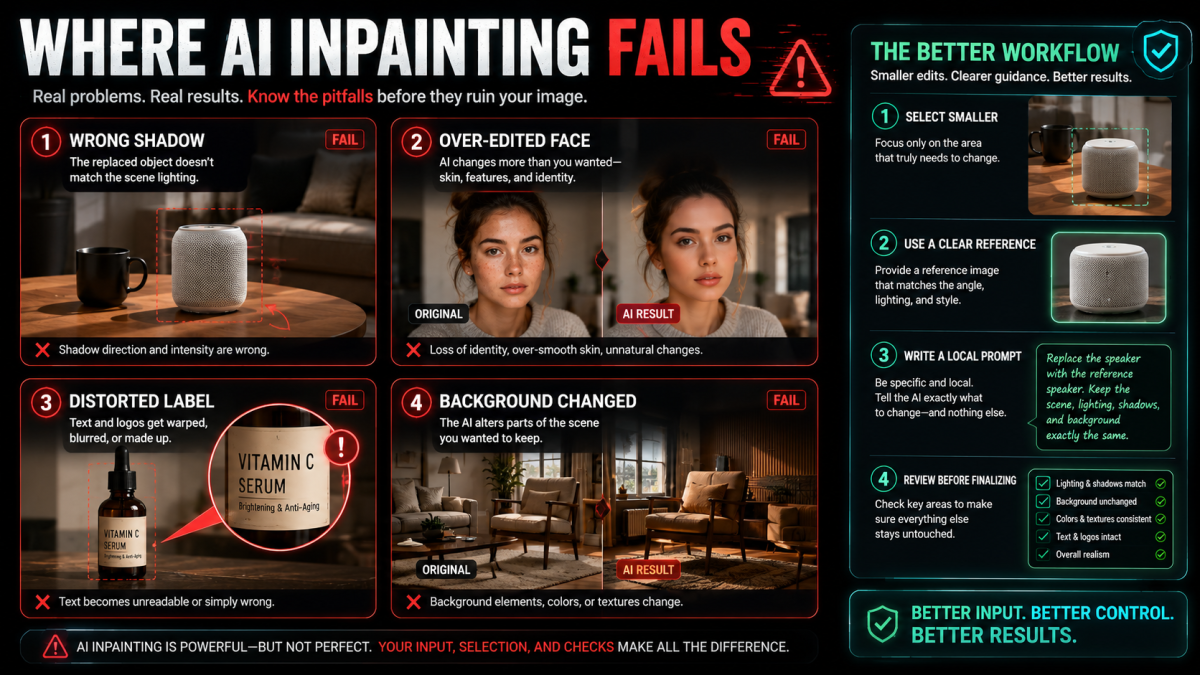
Watch for these problems before publishing: the whole image changes instead of one region, the replacement object looks pasted in, logos or labels become inaccurate, faces or hands drift, edges look melted, or the background becomes too smooth. The safer workflow is to select a smaller area, keep the global prompt conservative, add reference images when accuracy matters, and review product details manually.
How We Chose the Best AI Inpainting and Generative Fill Tools
This comparison focuses on workflow fit, not product logos. We evaluated area selection control, prompt accuracy, background preservation, object replacement quality, reference image support, ease of use, export quality, and the real workflow each tool is best suited for.
To keep the review practical, we used the same buyer task as the lens for every tool: replace one visible object in a real photo, preserve the surrounding lighting and background, and produce an output that could be reviewed for an ad, product page, social post, or design mockup. We did not treat this as a lab benchmark because tool access, models, credits, and interface details change often.
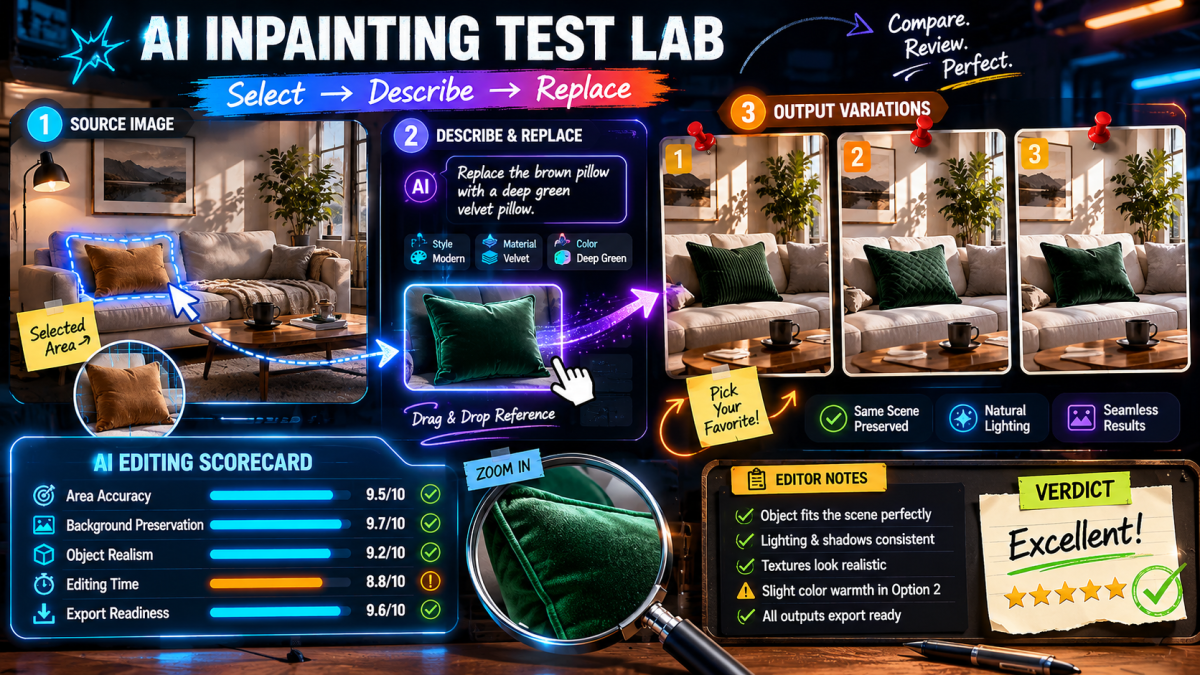
Before Publishing an AI-Edited Image, Check These Details
AI inpainting is fast, but the final review still needs human judgment. This is especially important for ecommerce, ads, client work, and any image that includes people, products, logos, or text.
- Product shape: the replacement should match the intended product, prop, clothing, furniture, or object silhouette.
- Logo and text accuracy: labels, packaging, brand marks, UI text, and small typography should not be hallucinated.
- Shadow and reflection: the new object should share the same light direction, contact shadow, reflection, and surface logic.
- Background continuity: walls, fabric, hair, skin, floors, and repeated textures should not look over-smoothed or melted.
- Face and hand quality: identity-critical areas need extra review, especially when the edit touches hair, skin, fingers, glasses, or jewelry.
- Export size: confirm the image is large enough for the final platform, ad placement, product listing, or design review.
- Commercial usage and rights: check the current terms for the tool, model, reference image, and final distribution channel.
How to Test AI Object Replacement Tools Before Choosing One
Before choosing an AI image editor, test the same real image across two or three tools. Do not compare polished demo images against your actual workflow. A good test takes less than 20 minutes and gives better evidence than a feature list.
Use this process:
- Choose one real source image, such as a product photo, room shot, portrait, ad creative, or social post.
- Define the local edit in one sentence, such as “replace the chair with the reference chair and keep the room unchanged.”
- Select the smallest area that contains the object and its contact shadow.
- Add one reference image if the replacement needs a specific shape, product, texture, or style.
- Generate 2 to 3 variations per tool.
- Score each result on area accuracy, background preservation, object realism, edit time, and export readiness.
The winning tool is not always the most famous one. It is the one that changes the intended area, preserves the rest of the image, and gets you closest to publishable output with the least cleanup.
FAQ
What is the best AI tool to edit only part of an image?
The best tool depends on the job. PixVerse Image Region Editor is useful when the edit needs selected areas plus reference images. Photoshop Generative Fill is better for professional layer-based editing, Midjourney Vary Region fits AI artwork, Pixelcut fits fast ecommerce cleanup, Kapwing and Fotor fit quick browser edits, and Picsart fits mobile creators.
What is AI inpainting?
AI inpainting is an image-editing technique where AI fills or changes a selected part of an image based on surrounding pixels and the user’s prompt. It is commonly used to remove objects, replace objects, repair missing areas, or add new details inside an existing photo.
What is generative fill?
Generative fill is a prompt-based editing workflow where AI adds, removes, or replaces image content inside a selected area. It is closely related to AI inpainting, but the term is often used for creative tools that generate new visual content from a text instruction.
Is outpainting the same as inpainting?
No. Inpainting changes a selected area inside the existing image. Outpainting expands the canvas beyond the original borders, which is better for changing aspect ratio, extending a background, or creating more space around a subject.
Can AI replace an object in a photo?
Yes. AI object replacement tools can remove an object from a selected area and generate a new object in its place. The best results usually come from clear selections, specific prompts, and reference images that show the target object, material, angle, or style.
Which AI image editor can use a reference image for replacement?
PixVerse Image Region Editor is built for reference-led selected-area editing. It supports reference images alongside overall and region-specific prompts, which is useful when the replacement needs to match a product, outfit, furniture piece, material, or visual style.
How do I keep the rest of the image unchanged?
Use the smallest selection that covers the object or area you want to edit, keep the prompt focused on that area, and avoid describing a completely new scene. If the tool supports region prompts, use them to separate the local edit from the overall image direction.
Is Image Region Editor free to try?
You can start from Image Region Editor and check the current account, credit, model, and usage options before scaling a workflow. Pricing, limits, and model availability can change, so verify the current details inside the app.
Final Recommendation
Choose the tool by workflow. Choose PixVerse Image Region Editor when the edit depends on selected regions plus reference images and the rest of the image needs to stay stable. Choose Photoshop / Firefly when the work needs professional layers and manual refinement. Choose Midjourney when the source is AI artwork. Choose Gemini or Nano Banana-style workflows when conversational editing is enough. Choose Pixelcut for quick ecommerce replacement, Kapwing for browser-based social edits, Fotor for casual generative fill, and Picsart for mobile creator content.
The most reliable AI image-editing workflow is not “type one big prompt and hope.” It is select the area, describe the change, add references when accuracy matters, then review the output against the original photo.
When a framing change needs more background around the original image, Magic Extend can help expand the composition.